What Size Furnace Filter Do I Need? How to Find It and Never Forget It
I bought the wrong size twice before I figured this out. Here's how to find your filter size in 60 seconds — and make sure you always have it when you need it.
- What the numbers on a furnace filter mean
- Where to find your furnace filter size
- Common residential furnace filter sizes
- AC unit filter sizes — same filter, different system
- How often to change your furnace filter
- Best furnace filters by MERV rating
- Filter sizes by brand — Carrier, Trane, Lennox, Honeywell
- How to remember your filter size
- FAQ
I've done the thing where you pull out the old filter, think you remember the size, drive to Home Depot, and come back with a 20×25×1 when you needed a 16×25×1. Back to the store, or just leave the wrong one in because you don't want to make another trip. I did this twice before I finally wrote it down somewhere I'd actually find it.
Furnace filter size is completely obvious once you know it — and completely invisible until the moment you need it. Here's how to find it, what the numbers mean, the best filters to buy, and how to make sure you always have it.
What the numbers on a furnace filter actually mean
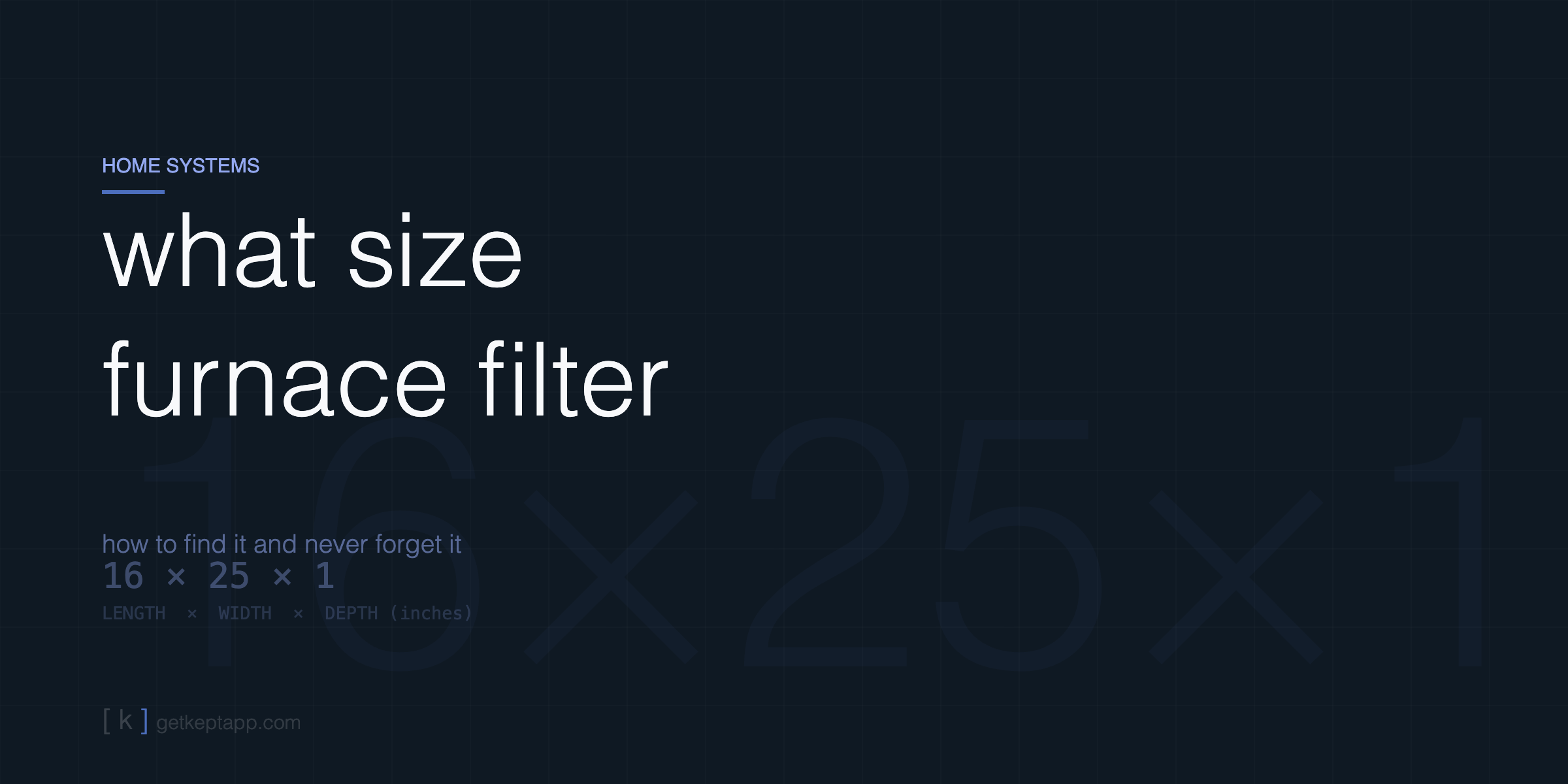
Furnace filters are labeled with three dimensions: length × width × depth (thickness). A filter labeled 16x25x1 is 16 inches wide, 25 inches tall, and 1 inch thick. That's it.
The most common residential filter thicknesses are 1 inch and 4 inches. Most standard furnaces use 1-inch filters. Higher-efficiency systems and whole-home air cleaners often use 4-inch or 5-inch media filters — these last longer (typically 6–12 months vs. 1–3 months for 1-inch filters) but cost more upfront.
The length and width are specific to your furnace model. There's no universal standard — a 20x25x1 and a 16x25x1 are two completely different filters. Using the wrong size means air bypasses the filter entirely.
Where to find your furnace filter size
There are four reliable places to look:
1. The filter itself
If there's already a filter in your furnace, pull it out. The size is printed on the cardboard frame. Every filter has it. This is the easiest method — assuming someone installed the right size last time.
2. Inside the filter compartment
Many furnaces have the filter size printed or stickered directly inside the filter slot. Open the compartment and look at the edges of the opening. Some manufacturers put a label right there for exactly this reason.
3. The furnace data plate
Every furnace has a metal data plate — usually inside the front panel or on the side of the unit. It lists the model number, serial number, BTU rating, and sometimes the recommended filter size. If the filter size isn't on the data plate, note the model number and search it online — the manual will have the spec.
4. Measure the opening
If all else fails, measure. Use a tape measure to get the length, width, and depth of the filter slot. Round to the nearest inch — filter sizes are nominal, meaning a filter sold as "20x25" might actually measure 19.5×24.5. That's normal. Buy the nominal size that matches your measurement.
Pro tip: The nominal size is what you buy. The actual size is slightly smaller. Don't buy a filter whose nominal size is smaller than your opening — you'll get air gaps around the edges and the filter will fall out.
Common residential furnace filter sizes
| Size | Common in |
|---|---|
| 16×20×1 | Older homes, smaller systems |
| 16×25×1 | Very common in mid-size homes |
| 20×20×1 | Square filter slot configurations |
| 20×25×1 | One of the most common residential sizes |
| 20×25×4 | Higher-efficiency media filter systems |
| 16×25×4 | Carrier, Trane, and similar high-efficiency systems |
| 20×25×5 | Lennox and other whole-home air cleaners |
If your size isn't in that table, don't panic — there are dozens of less common sizes and your furnace might use one of them. Measure the opening and go from there.
AC unit filter sizes — same filter, different system
If you're looking for AC unit filter sizes, you're in the right place. Central air conditioners and furnaces share the same air handler and the same filter. The filter that goes in your furnace is the same filter that cleans the air going through your AC system. There's no separate AC filter in a central HVAC system — it's one filter for both.
The confusion usually happens because people think of them as separate systems. They're not. The filter sits in the air handler or return air duct, and all air — whether heated or cooled — passes through it.
So if you're searching for your AC filter size: it's the same size as your furnace filter. Use the same methods to find it — check the existing filter, the filter compartment label, or the air handler data plate. For a full reference of every standard size and MERV option, see the AC filter sizes guide.
Window AC units are different. A window or portable AC unit has its own separate filter — usually a small mesh screen that slides out from the front. These are washable on most units and don't have size numbers — just rinse and reinstall. Only central HVAC systems use the sized filters discussed in this article.
How often should you change a furnace filter?
The standard recommendation for 1-inch filters: every 1–3 months. More often if you have pets, allergies, or someone with asthma in the house. Less often (closer to 3 months) if you have a newer home with few occupants, no pets, and good construction.
For 4-inch media filters: every 6–12 months. These are thicker, hold more debris, and are designed to last longer.
The real answer is to check it. Pull the filter out every 30 days for the first few months until you get a feel for how fast it gets dirty in your home. A filter that looks gray or has visible debris on the surface needs to be replaced regardless of how recently you installed it.
A clogged filter doesn't just reduce air quality — it makes your system work harder, increases energy costs, and can cause your heat exchanger to overheat and fail. A $10 filter protects a $3,000 furnace.
How I finally stopped forgetting my furnace filter size
This is the part that tripped me up for years. You look up your filter size, replace the filter, and three months later you're standing in the store again with no idea what you bought. I know this because I did it at least three times.
The obvious solutions I tried:
- Taking a photo of the old filter and then losing it in their camera roll
- Writing it on a sticky note on the furnace (works until it falls off)
- Leaving the old filter nearby as a reference (disgusting, and it eventually disappears)
- Just buying a bunch at once — but then you need to remember where you put them
The actual fix is to put it somewhere you'll always be able to find it: your phone, in a place that's organized around your home, not buried in notes or photos.
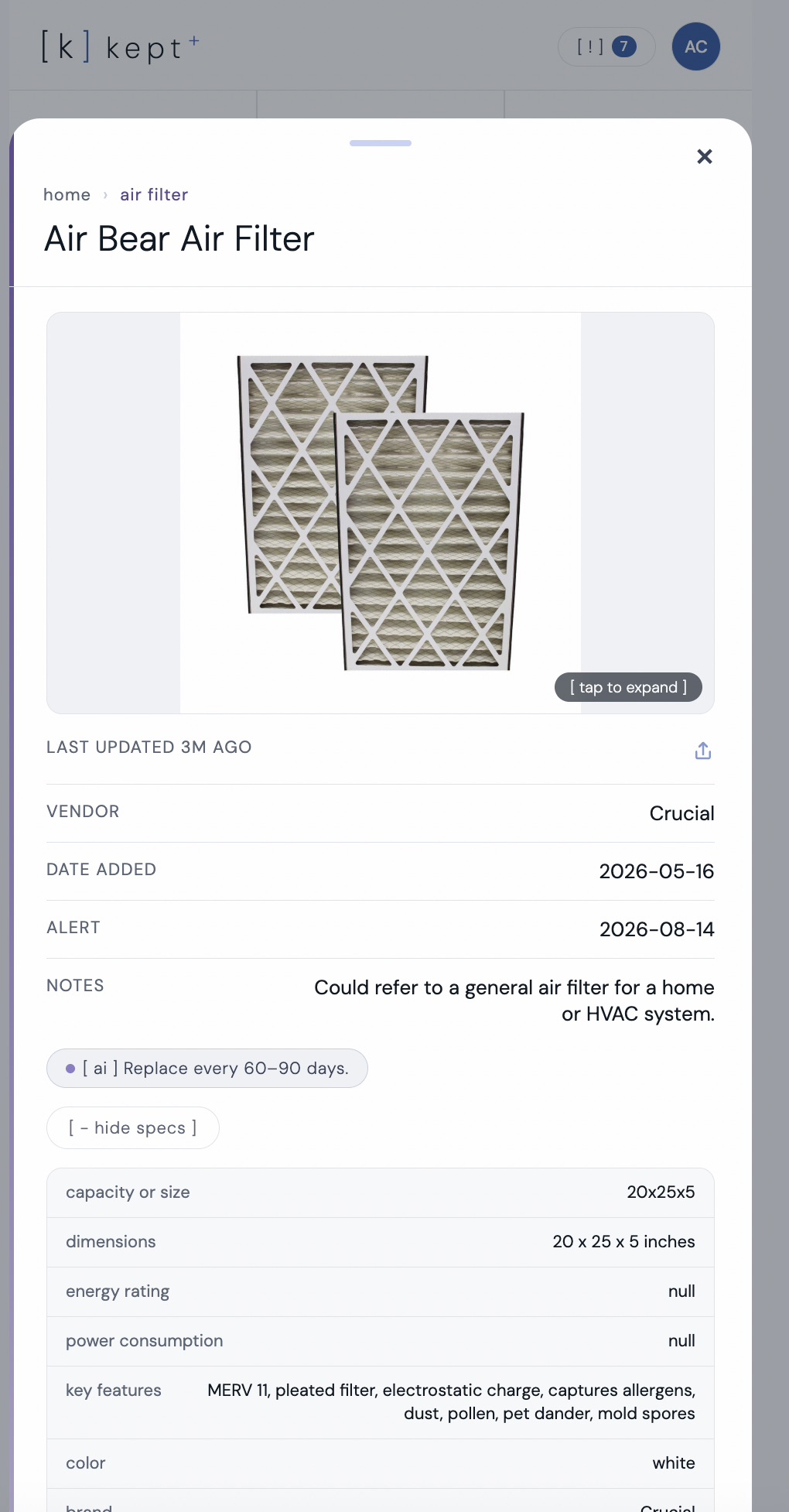
Here's what that looks like in kept — the filter size saved to the item, the last-changed date logged, and a reminder set so you never stand in the filter aisle guessing again.
Best furnace filters — what to actually buy
You don't need to overthink this. Here's what to buy based on your situation. If you want a deeper dive into MERV ratings and what each level actually catches, see the complete guide to best furnace filters.
Best furnace filters for most homes — MERV 8
For the average home with no special air quality concerns, a MERV 8 filter is the sweet spot. It captures dust, pollen, mold spores, and pet dander without restricting airflow. Changed every 1–3 months, it keeps your system running clean.
Good options: Filtrete 600, Nordic Pure MERV 8, Honeywell Home MERV 8. All are widely available and reasonably priced.
Best furnace filters for allergies and pets — MERV 11
If you have pets, allergies, or someone with asthma in the house, step up to MERV 11. It captures finer particles including pet dander, fine dust, and some smoke. Change every 60 days if you have pets — they fill filters faster.
Good options: Filtrete 1000, Nordic Pure MERV 11, Honeywell Home Elite Allergen.
Best furnace filters for high-efficiency systems — MERV 13+
MERV 13 captures bacteria, smoke, and fine particles — but only use it if your system is rated for it. Check your furnace manual or data plate. Most standard residential furnaces max out at MERV 11. Putting a MERV 13 filter in a system designed for MERV 8 restricts airflow and can damage your blower motor.
Good options: Filtrete 1500, Nordic Pure MERV 13. Only if your system supports it.
Should you buy the cheapest filter or the best one?
Filters are rated by MERV (Minimum Efficiency Reporting Value). Higher MERV = smaller particles captured. Here's what each level captures:
For most homeowners, a MERV 8–10 filter changed on schedule is the right call. You don't need to buy the most expensive option — you just need to actually change it.
Filter sizes by brand — Carrier, Trane, Lennox, Honeywell
Different HVAC brands have common filter sizes associated with their systems. If you know your furnace brand but can't find the label, these are the most common sizes to start with — but always verify by measuring or checking the data plate.
Carrier furnace filter sizes
Carrier systems most commonly use 1-inch and 4-inch filters depending on the model. The Carrier Infinity and Performance series often use 16×25×4 or 20×25×4 media filters in a dedicated filter cabinet, while base-tier Carrier furnaces typically use standard 1-inch filters.
Trane furnace filter sizes
Trane XR and XV series systems commonly use 1-inch filters in standard sizes, while the CleanEffects air filtration system uses its own proprietary filter. Most Trane residential furnaces without a dedicated filter cabinet use 16×25×1 or 20×25×1.
Lennox furnace filter sizes
Lennox is known for its whole-home air purification systems, which often use proprietary 20×25×5 media filters — specifically the X6673 or similar. Standard Lennox furnaces without an air purifier use 1-inch filters in common sizes.
Honeywell furnace filter sizes
Honeywell (now Resideo) makes both furnaces and whole-home air cleaners. Their media air cleaners typically use 20×25×4 filters. Standard Honeywell/Resideo furnaces use common 1-inch sizes. Honeywell also makes the popular Home line of replacement filters sold at retail.
The one thing that will actually improve your furnace filter situation
It's not the filter brand. It's not the MERV rating. It's knowing your size and changing it on time.
Look up your filter size today. Write it down somewhere you'll actually find it — not in a note that gets buried, not on a sticky note that falls off the furnace. Put it in your phone where it lives with the rest of the stuff you need to know about your house.
Then set a reminder. 90 days from now. That's it. Your furnace will thank you.
kept is built for exactly this
Add your furnace, log the filter size, set a 90-day reminder. Next time you're standing in the filter aisle, open kept and you know in 5 seconds. [ kept ] — free to try, no account required.
try kept freeFAQ
What size furnace filter do I need?
Check the old filter — the size is printed on the cardboard frame in L×W×D format (e.g. 16x25x1). If you don't have the old filter, measure the filter slot opening with a tape measure and round to the nearest inch. Most furnaces use standard sizes like 16×25×1, 20×25×1, or 20×25×4.
What do the numbers on a furnace filter mean?
The three numbers are length × width × depth (thickness) in inches. A 16×25×1 filter is 16 inches long, 25 inches wide, and 1 inch thick. All three numbers must match your furnace's filter slot. The depth (1-inch vs 4-inch) is especially important — these are completely different filter types.
Where do I find my furnace filter size?
Four places: the old filter (size is on the frame), inside the filter compartment (some have a sticker), the furnace data plate (metal label on the unit), or measure the opening yourself. If you have a filter cabinet separate from the furnace, check inside the cabinet door.
How often should I change my furnace filter?
Every 1–3 months for 1-inch filters. Every 6–12 months for 4-inch and 5-inch media filters. More often if you have pets, allergies, or high dust. The real answer: check it monthly until you know how fast it fills up in your home. A gray, debris-covered filter needs to be changed regardless of schedule.
What is the best furnace filter to buy?
For most homes: MERV 8 (Filtrete 600, Nordic Pure MERV 8). For allergies or pets: MERV 11 (Filtrete 1000, Honeywell Elite Allergen). For high-efficiency systems only: MERV 13. The best filter is the one that matches your system's max MERV rating and that you actually change on schedule.
Can I use the same filter for my AC and furnace?
Yes — in a central HVAC system, the furnace filter and AC filter are the same filter. All air passes through one filter whether the system is heating or cooling. There's no separate AC filter. If you have a window or portable AC unit, that has its own washable mesh screen — not a sized disposable filter.
What happens if I use the wrong size furnace filter?
A filter that's too small leaves gaps around the edges — unfiltered air bypasses it entirely and your system runs dirty. A filter that's too large won't fit in the slot or will buckle and collapse. Either way, your furnace is running without real filtration. Always use the exact nominal size for your system.